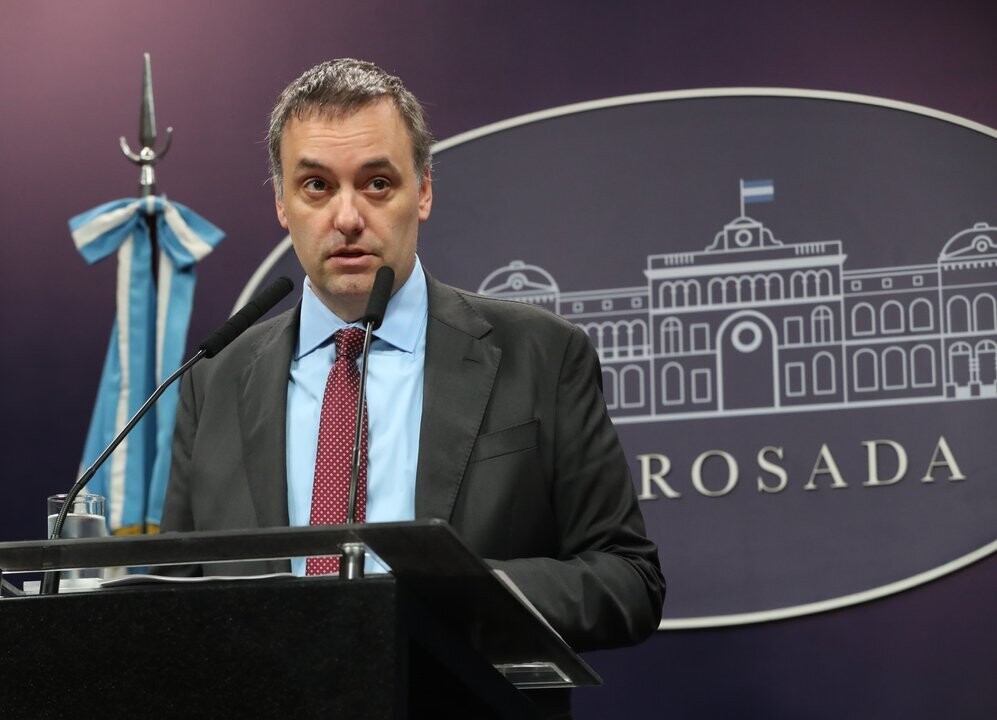
Buenos Aires, Dec 9 (NA) - Cabinet Chief Manuel Adorni highlighted this Monday that 'of the 10 points proposed' in the May Pact, '8 were addressed' within the framework of the May Council, clarifying that 'federal co-participation requires the presence of all governors' and 'the predictable reform requires prior modifications to the labor scheme'. As had been advanced by the Argentine News Agency, the Executive Branch will send the initiatives to Congress for extraordinary sessions, while others will be forwarded 'during the 2026 legislative period'. Adorni stated this at a press conference from the Government House, noting that these projects 'will lead to a future of freedom and prosperity, which is, in a way, the only reason we are here and the only reason we came to govern Argentina'. Adorni highlighted that throughout the semester, '6 plenary meetings' were held, all with 'perfect attendance' from its members, with the exception of Tuesday's session, from which the head of the UOCRA, Gerardo Martínez, was absent, as Adorni said, because he was returning on a flight from Washington. The coordinating minister also reiterated that the May Council is 'consultative but not binding', although most of the projects will be sent to Congress. On the first point, 'inviolability of private property', Adorni stated that it was decided that 'regarding rural lands, the purchase by foreign private individuals is released' and affirmed that 'the prohibition of changing the agricultural productive activity for 30 to 60 years after a fire is also eliminated, a law by Deputy Máximo Kirchner that directly attacks production'. Sturzenegger, at the helm of the May Council. It seeks 'not to prohibit modalities such as distance, hybrid, and community education, all under mandatory supervision based on national and jurisdictional standards', he detailed. Cornejo, in the May Council. The proposal prepared by the Legal and Technical Secretariat was fed by each of the Council's comments'. 'It will be reviewed, there will be a review of the cold zone regime, also already included in the 2026 Budget'. On the Glaciers Law, Adorni stated that President Javier Milei 'already announced that it will be sent to extraordinary sessions. And there will be an update to the Forest Law, modification of the Aquaculture Law, and the elimination of provincial purchase laws and local labor caps', he added. And he maintained that 'a topic on which the Council wants to warn, given the boom in mining, is that it is imperative that the factor market be integrated as a single market throughout the country and not by setting caps that only complicate the activity'. Labor Reform Regarding the 'modernization' promoted by the Government, Adorni anticipated that the 'final project', not yet disclosed, 'what stands out the most is ultra-activity, precedence of collective agreements, labor tax burden; issues for self-employed workers, that is, platform workers, and in fact, this is a project promoted by Deputy (from PRO, Cristian) Ritondo, in addition to the elimination of telework', pushed in academia and that, he said, 'did not have the desired effect'. UCR Senator Carolina Losada.